
Sheffield Warrant Checks
Sheffield publishes no online warrant portal, so build your Sheffield warrant check from the state level. Open Iowa Courts Online, a public case and payment index, and search by exact legal name, date of birth when allowed, citation number, or full case ID, choosing Franklin County and the likely case type. Treat any result as a case lead rather than final warrant confirmation, since new, sealed, juvenile, and confidential records may be absent. Then call the Franklin County Clerk of District Court at 641-456-5626 to confirm court status. Sheffield Police answers city process questions at 641-892-4301, and FCSO's 24-hour non-emergency line, 641-456-2731, handles county service and custody routing for matters that reach beyond the city.
- Gather the exact name, birth date, citation, and case number.
- Search the state court index under Franklin County.
- Confirm the latest entry with the District Court clerk.
- Ask Sheffield Police only about city agency or service routing.
- Ask the court or a lawyer about appearance, payment, bond, or motion.
No Sheffield Warrant Portal
The official Sheffield site lists city services and contacts, but it offers no warrant search of any kind.

The city website is a contact route, nothing more. It is not an arrest roster or a District Court docket, and a blank result there does not prove no warrant exists; it only means the city does not publish warrant data on that page. For a case lead, use Iowa Courts Online, then ask the clerk about the official docket. When your question concerns police service or a city-held citation record, contact Sheffield Police or the city clerk and describe the issue narrowly.
Policing and Courts in Sheffield
Sheffield runs its own police department. It has no separate municipal trial court. Iowa District Court, District 2, Franklin County handles trial matters, including traffic cases, simple misdemeanors, and municipal infractions. A magistrate or judge issues a warrant, and Sheffield city police may execute it within their lawful authority.
Sheffield Police Department
310 S 3rd St, Sheffield, IA 50475
641-892-4301
City-police and service-routing questions
Sheffield City Hall
110 S 3rd St, PO Box 252, Sheffield, IA 50475
641-892-4718
City clerk and municipal-record routing
The official staff listing names City Clerk Ashley Francis and Police Chief Andrew O'Connor. Those contacts are useful, but they cannot replace the District Court clerk for warrant status or any judicial action.
Sheffield Police Warrant Contact
The official Sheffield staff page gives the city clerk and police contact.
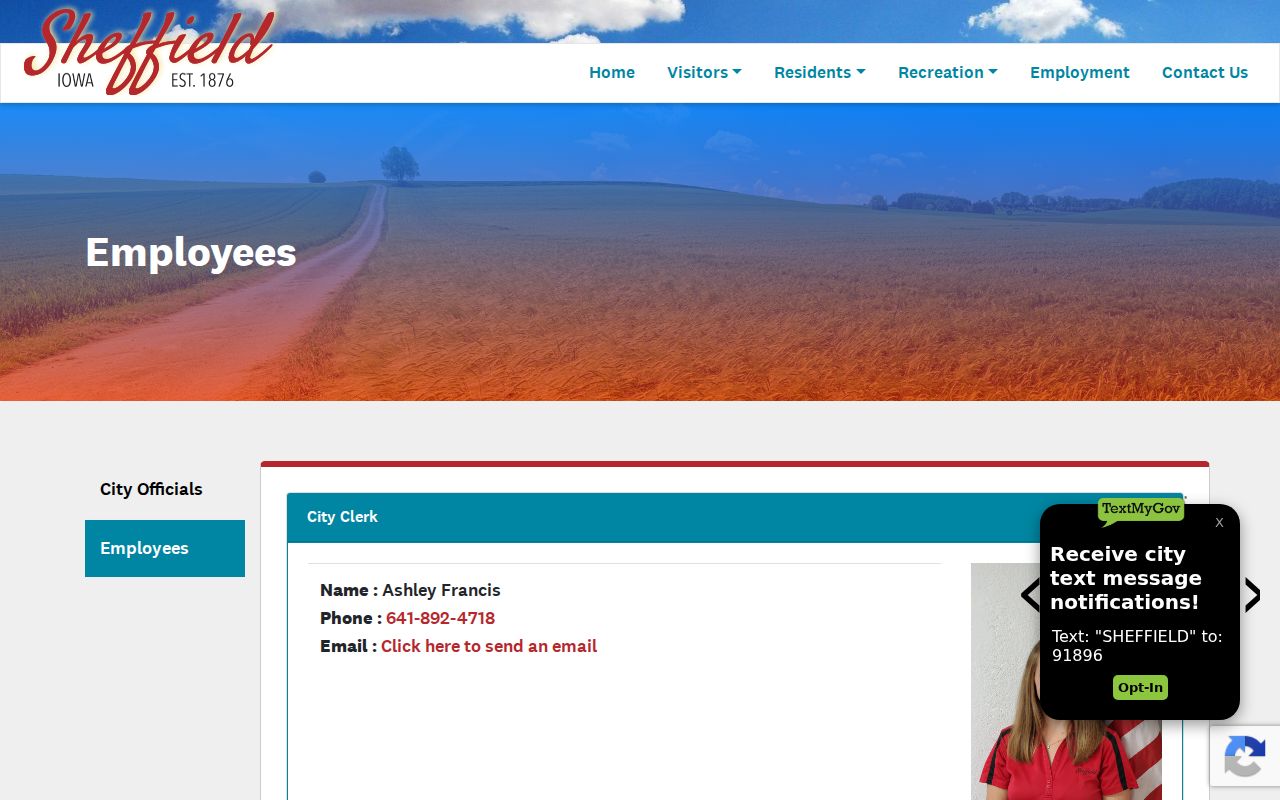
The listing identifies the right city office for a question about Sheffield Police activity; it is not a person-name warrant lookup. Before calling, check the court case when you can and have the case or citation number ready. Ask whether Sheffield Police is the serving agency and where a time-sensitive process question should go. Police staff cannot give legal advice or withdraw a court order. Only the issuing court can recall its warrant.
Warrants in Sheffield: The Main Types
Warrant labels track different court powers. Iowa Code §805.5 calls for an arrest warrant when a defendant fails to appear as promised on a citation, and "bench warrant" is plain language for that court-issued failure-to-appear process. Sheffield's administrative search warrants, by contrast, come from the city code and concern inspections or code enforcement, not a public arrest list.
| Type | How it arises | Issuer |
|---|---|---|
| FTA arrest warrant | Required citation appearance missed | Iowa District Court |
| Arrest warrant | Complaint and probable cause support arrest | Judge or magistrate |
| Administrative search warrant | City inspection need meets Chapter 808 rules | Iowa District Court |
| Search warrant | Probable cause supports a search | Authorized judicial officer |
A municipal infraction is a city enforcement matter, but its court path still runs through District Court under Iowa Code §364.22.
Sheffield Administrative Search Warrants
The Sheffield code page opens the 2025 city code and its enforcement provisions.
The code lets city officials apply to Iowa District Court for an administrative search warrant under Iowa Code Chapter 808. It creates no Sheffield arrest-warrant roster.
Important distinction: authority to seek an inspection warrant is not authority for the public to search arrest records by name.
The provision separates the roles cleanly. A Sheffield official applies, and a judicial officer decides whether lawful grounds exist, with the resulting search-warrant material following its own confidentiality and return rules.
Sheffield Warrant Records: What They Show
A Sheffield-related court record may show case identifiers, parties, charges, dates, bond events, service, and disposition. Visibility varies with case type and timing. A format like SMCR012345 is only a sample Iowa-style ID.
| Case ID | Identifies the docket and case type. |
|---|---|
| Named party | Shows the name held by the court. |
| Original offense | States the charge or citation behind the process. |
| Issuing court | Identifies Iowa District Court or another proper court. |
| Bond | May show type, set amount, posting, or no public value. |
| Return and status | May show issue, service, return, recall, or disposition. |
Name-only matches can be wrong. Confirm identifiers and the current docket with the clerk.
Missed Sheffield Citation Steps
A missed Sheffield citation date can trigger the Iowa §805.5 process. The court may issue an arrest warrant for the original offense and the failure to appear, and the clerk sends it to the issuing law-enforcement agency. After an arrest, the warrant and citation return to the court. The court controls that whole sequence.
Process: citation › missed appearance › court warrant › clerk transfer › agency service › return to court.
Ask the clerk whether the court wants a hearing, payment, bond, or a motion. Payment alone does not guarantee a recall. Sheffield has no surrender window, recall form, amnesty program, or published bond schedule. If arrest is possible, get legal advice before you appear.
- Confirm the case and required date.
- Ask whether a warrant is active.
- Learn which agency received it.
- Ask what court action is required.
- Keep proof of payment or filing.
Sheffield Warrants and Franklin County
A Sheffield police matter can grow into a Franklin County District Court case. Court status and warrant-return records sit with the clerk, while Sheffield Police handles city agency questions and FCSO may route county service or custody. The Franklin County warrant records overview explains the county system.
Warrant flow: Sheffield citation or police case › Iowa District Court › Sheffield Police or FCSO service › court return and updated docket.
Iowa has no public statewide warrant roster. The state case index is only a lead, and official confirmation comes from the court and the agency assigned to the case.
Sheffield Warrant Custody Questions
Franklin County runs no jail of its own, so a person arrested in Sheffield can land in Hardin, Butler, Wright, or Cerro Gordo County under holding agreements. For custody-location routing after a Sheffield arrest, call FCSO at 641-456-2731. Guessing that someone stayed in Sheffield or Hampton leads nowhere. Release terms depend on the case. Iowa law permits personal recognizance or an unsecured appearance bond in some matters, while the court can set conditions, secured bond, or no bond at all. Once you reach the holding office, ask what order controls release, who accepts bond, and which payment forms they take. The city publishes no bond figure for Sheffield cases and no warrant-specific fee.
Accessing Sheffield Warrant Records
Send each request to the office that actually holds the record. Sheffield Police can release a city citation or service record on request. The Franklin County Clerk of District Court handles dockets and warrant returns. Name a case, a date range, and a record type; nobody answers a request for a broad warrant roster.
Key rules:
Iowa Code Chapter 22 grants access to public records subject to exceptions.
Iowa Code §804.29 restricts arrest-warrant information before arrest and return or initial appearance.
Iowa Code Chapter 808 governs search-warrant process and confidentiality.
These limits explain why a no-result search cannot clear a Sheffield warrant.
Sheffield Warrant Role Comparison
Three offices, three different answers. The city clerk routes municipal records for Sheffield. Sheffield Police handles local service and agency process, while the District Court clerk confirms court status, filings, fines, and warrant returns. Send each question to the right desk, or the reply stalls.
Custodian: the office responsible for a specific public record.
Return: the filed record of warrant execution or disposition.
Recall: a court act that withdraws an outstanding warrant.
FTA: failure to appear for a required court event.
The 2020 Census table puts Sheffield at 1,130 residents. That number describes the city, not its warrant volume, and the city publishes no warrant count at all. What sets Sheffield apart is its own police department working inside Iowa's unified District Court system.
Confirming a Sheffield Warrant Update
Payment, an appearance, a court recall, and the update in an agency's system are four separate events. Start with the District Court clerk. Ask whether money posted, whether a hearing is still set, and whether a judge signed an order changing the warrant. Then ask the serving agency if it received that order, because a receipt proves payment, not recall. Give the exact case ID, citation number, date, and legal name. If Iowa Courts Online looks stale, ask how long posting takes; do not pay twice just because the public index lags. Keep every receipt, motion, appearance notice, and order. Those papers help officials trace one event across court and agency systems. Sheffield publishes no recall application and charges no clearance fee. Court staff can explain the procedure but cannot recommend a legal course. An attorney can handle disputed identity, appearance, bond, or a motion. Sheffield Police cannot cancel a District Court order, and the city clerk cannot certify that an arrest warrant is gone.